

How Much Money Is Received When Donating At Csl Plasma In Greece Ny
Photograph by Stacie Lewis
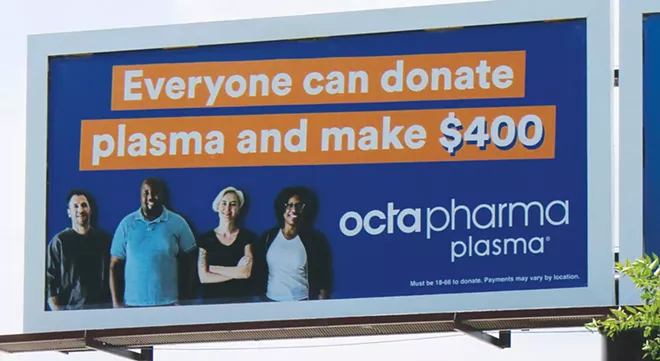
A billboard at 11th Street and South Grand Avenue touts how much money an individual can make by donating plasma.
Plasma is already widely used for a variety of life-saving medical procedures, and information technology'south at present being tried as a possible means of treating COVID-nineteen patients. However, plasma cannot be reproduced in a lab – only the human trunk can produce information technology. That means identifying willing donors, and in the U.S., paying for plasma equally a ways of incentivizing donors.
A booming business
Plasma is large business, with blood products accounting for more than than i.9% of American exports in 2016, more than than soybeans or computers ("What is the blood of a poor person worth?," New York Times, Feb. 1, 2019). For this reason, the U.S. is often referred to as the OPEC of plasma.
Globally, plasma is currently a $26 billion industry, with the marketplace growing 6-10% yearly. According to a recent ProPublica report, the United States had more than 800 plasma centers at the finish of 2019, with more beingness built regularly. This trend also holds true in Springfield, with 2 for-profit plasma centers currently under construction, in addition to an existing privately owned plasma business.
Octapharma Plasma, a Swiss biopharmaceutical company, has had a presence in Springfield for years; it's been located at 1770 Wabash Ave. in the Chatham Square shopping center since 2013. Octapharma will presently be joined past two other plasma centers.
The onetime Aldi location in the Well-nigh North Crossing shopping centre, 1150 N. Fifth St., is being remodeled for a new tenant, CSL Plasma. The visitor is a sectionalization of CSL Behring, headquartered in Pennsylvania, although the parent visitor, CSL Limited, is headquartered in Australia.
CSL Plasma will initially employ 20-25 people only plans to grow to a staff of threescore or more, according to bounded managing director Scott Newkirk. "Positions include leadership positions in direction and quality, medical staff, phlebotomists and donor screening," he said.
KEDPLASMA USA, a subsidiary of Italian company Kedrion Biopharma, announced earlier this twelvemonth it will interruption footing for a new facility near the intersection of North Grand Avenue and Walnut Street, next to DaVita Dialysis, with an predictable opening in January 2021. Earlier this yr, the Springfield City Council approved a zoning change to the nigh two acres of state to let for construction of an 11,900-square-human foot part building.
Both new facilities, less than a mile apart, will be located within the boundaries of the Mid-Illinois Medical District.
Forrest McCaleb, director of global communications for Kedrion Biopharma, said that when searching for a new location, the company tends to stick to smaller communities like Springfield.
"Kedrion is a family-owned concern, and we like to see family values reflected where nosotros are," McCaleb said. Although Kedrion is an international company established in Italian republic in 2001, the roots of the companies from which it was born stretch back several decades in the production of claret and plasma-derived products.
Additionally, he said, Kedrion takes into consideration the age of the population and viral marker rates for diseases that would exclude a donor, such equally HIV and hepatitis A and B. According to McCaleb, the company will employ forty-45 people once the facility opens.
Scott Stough, chief operating officer at The Stough Group, the evolution visitor responsible for edifice and managing Kedrion'southward new facilities, noted the site in Springfield is in close proximity to the medical facilities. Stough is the 3rd generation of the family unit business concern, which now focuses on real estate development for plasma centers, having sold off the operations side of the business concern in 2006 to an international company.
In a February interview with Springfield Business Periodical, Stough said, "Due to the working-class population and demographics of Springfield, nosotros felt that information technology would be ideal to not simply be in the medical commune but to exist an asset to the community and grow the footprint of the medical commune onto Due north Yard."
Stough Development Corporation, based in Cincinnati, Ohio, has built plasma centers in 17 states and has projects underway in Lincoln, Nebraska; Jacksonville, Florida; Mobile, Alabama; and Augusta, Georgia, along with 3 in Illinois. In addition to Springfield, the company is currently building new centers in Champaign and Joliet.
Plasma and the donation process
Plasma makes up ane of four parts of the blood, the other iii being cherry-red claret cells, white claret cells and platelets. Plasma is largely composed of water, just is also a rich source of proteins, clotting agents, albumin and immunoglobulins (antibodies), making it an ideal handling for hemophilia and other clotting disorders, immunodeficiency diseases, neurological conditions and genetic disorders. Additionally, plasma is used to support disquisitional intendance procedures such as surgeries, burns and organ transplants and is being investigated for its possible use in treating severely affected COVID-19 patients.
Plasma cannot be reproduced in a lab, nor acquired from any source merely human blood. Every bit a result, plasma donations are a necessary component of plasma-derived medicinal products (PDMPs). Plasma obtained from paid donors in the United states of america makes upwards 70% of the global supply of plasma and ninety% of paid plasma donations worldwide, generally because of the less-stringent restrictions and payment procedure of American plasma centers.
A paid plasma donor in the Us must be between 18 and 59 years of age, weigh at least 110 pounds and be in good overall health. Identification such as a driver's license, proof of Social Security number and accost are required, and the donor must reside in the surface area, in an attempt to exclude homeless or transient donors.
McCaleb provided some insights as to what to expect during the donation procedure. On the showtime visit, a potential donor will consummate a pre-screening process, answering questions almost health and lifestyle choices. Then vitals and weight will exist taken, as the amount of plasma donated is determined past the weight of the donor. The donor will then be taken back to the donation expanse for the plasmapheresis process, which begins with a needle inserted into the arm to extract whole blood. The plasma is separated through centrifuging and and so the remaining parts of the blood, sans plasma, are returned to the donor in a completely sterile and automated process.
After being given 500 ml of saline to replace the extracted plasma, the donor is compensated via a preloaded debit carte, made aware of referral and rewards programs and then discharged. The process for a beginning-fourth dimension donor takes a piffling more than two hours, with subsequent visits of xxx-60 minutes, though the wait to donate may accept significantly longer.
New donors are incentivized and tin can receive every bit much as $400 the first month due to offset-fourth dimension donor bonuses. A regular donor tin expect compensation ranging from $280 to $350 per month, depending on the donation eye. In the United States, plasma may be donated twice within a seven-day period, with at to the lowest degree one twenty-four hour period betwixt donations. Otherwise, there is no limit on the number of donations, significant a donor could potentially requite plasma 104 times a twelvemonth for consecutive years.
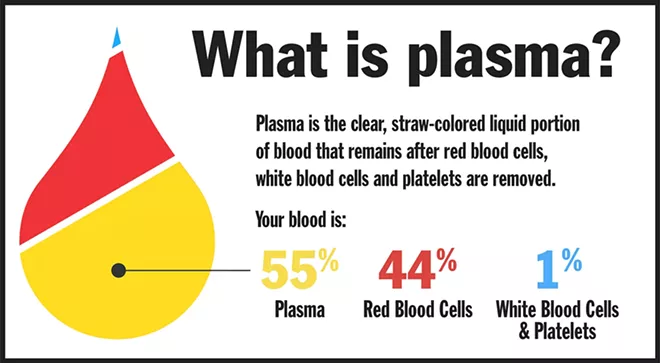
Infographic courtesy bpositivetoday.com
Later plasma is donated, it is immediately frozen and stored, with samples sent out for testing for various blood-borne diseases. If deemed condom, the accumulated plasma is sent to a fractionation facility where it is separated into the different components from which PDMPs are made, usually into injectable treatments, which are so distributed worldwide. The U.Southward. receives approximately twoscore% of the global share of PDMPs, and then much of the plasma collected in the U.South. is actually put to use in other countries.
Plasma donation centers follow Centers for Disease Control and Prevention guidelines for safety, with boosted precautions now taken during the pandemic. Adhering to strict cleaning protocols, staff habiliment confront shields and take the temperature of anyone inbound the building. Masks for donors are required. Beds for donation and chairs in the waiting room are socially distanced and, when at capacity, donors are encouraged to wait in their cars until their proper noun is called.
Poverty clouds the process
Though information technology saves endless lives, paid plasma donation is not without its critics. The twice-weekly collection schedule allowed in the United States is not routine in most parts of Europe, where donors are not compensated – though countries such as Italy may offer a paid vacation day to donors – and are limited to once every two weeks. Critics assert that poverty is the main commuter in paid plasma donation, not altruism, and that donors may exist risking their health with frequent donations in exchange for quick cash. According to a 2017 study by ABC News, nearly fourscore% of U.South. plasma centers are located in low-income neighborhoods.
The process is designed to accept only salubrious donors, but information technology is possible to crook the pre-screening process. Some homeless people get around the address requirement by having a local mailing address where they collect mail just do not live. Underweight donors may wear talocrural joint weights to authorize. Others outright lie about lifestyle and health to laissez passer through the process. Lured by the opportunity to brand quick money, others are addicts, mentally ill or disguise health atmospheric condition in club to be able to donate for much-needed cash.
Dr. Lucy Reynolds, a inquiry fellow at the London School of Hygiene and Tropical Medicine, told The Atlantic that, "Sure governments are people- and people's rights-centered. In those places they make the plasma corporations play by the rules; sometimes they just cull to have as little as possible to do with them. Just the Usa is a corporate state," noting that the U.S. maintains the least restrictive plasma donation regulations in the earth ("The Twisted Business of Donating Plasma," May 28, 2014).
This lack of regulations, some assert, can pb to disastrous consequences for individual donors. A Springfield-area paramedic, who spoke on the condition of anonymity due to her employment, said that she treats patients with side effects of plasma donation, on average, about once a calendar month. "Commonly it's from low blood pressure, lightheadedness, dizziness and feeling faint," she said.
Though donors are instructed to return to the plasma center if they experience a medical need, "It'south often a bystander who calls, or someone with them," reports the paramedic, explaining at that place'southward usually not fourth dimension to return to the plasma center, as many lose consciousness. Other donors but do not want the plasma center to know they are having medical bug, for fear that this will interfere with their next donation wheel. The paramedic said most of the cases she sees are taken to the hospital for care and normally revived with a full panel of electrolytes while their vitals are monitored.
A fellow paramedic, who also spoke on the condition of anonymity, noted, "We don't actually run into the salubrious people who donate, only the ones who are having issues from donating. For you and me, it wouldn't exist a problem because nosotros can replenish ourselves. Simply a lot of the homes we go into, in that location'south nil to swallow, nix in the cabinets. They only don't have the ways to replenish their bodies."
A complicated history
The history of the use of blood products has been problematic at times, with diseases shared between those who give and those who receive claret products, including plasma. Many have died, although increased safety standards take been implemented equally a result.
Hemophilia, a genetic disorder which currently affects near 20,000 Americans, prevents blood from clotting normally. This tin can cause a hemophiliac to drain longer afterward an injury, and over the course of a year, handling of one severe hemophiliac may crave 1,200 units of plasma, each unit the issue of a single plasma donation session.

Photograph courtesy of Casler Design Group
KEDPLASMA USA appear earlier this year it plans to construct an 11,900-square-foot building on North Grand Avenue just east of Davita Dialysis. Photograph COURTESY OF CASLER DESIGN Grouping
Most half of American hemophiliacs (and roughly 90% of severe hemophiliacs) contracted HIV in the early on 1980s from contaminated blood products, resulting in approximately four,000 patients eventually dying from AIDS. At the time, donations were largely sourced from the U.S. prison population. A course-action lawsuit filed by hemophiliacs and their families presented show that even after the discovery of tainted blood products, a major plasma company continued to distribute its older supplies. However, due to federal and state protections, plasma corporations were not penalized.
In the early to mid-1990s, Communist china implemented its "Plasma Economy," offer poor Chinese farmers payment for plasma donations. Due to low standards for safety and sanitation, equipment was routinely reused and collected blood was pooled before plasma was extracted, with shared blood beingness pumped back into individual donors. About forty% of donors contracted HIV and/or hepatitis, and more than a million rural Chinese citizens died as a result. This health crisis was suppressed by the Chinese government, as well as the business middlemen who reaped the financial benefits.
In the wake of these scandals, the Plasma Protein Therapy Association (PPTA) was formed in the 1990s. PPTA is a global organization representing the plasma donation and therapies industry, which "administers standards and programs that help ensure the quality and safety of plasma collection and manufacturing and protect both donors and patients." PPTA's goals include ensuring a safe procedure for the donation and collection of plasma while addressing the broad range of bug arising from the dynamic international plasma market.
PPTA has developed a voluntary International Quality Plasma Program that serves as a third-party evaluator for members of PPTA, designed to ensure a safety surroundings for donors and maintain standards for plasma centers.
In an interview with IT, PPTA director of global communications Mat Gulick asserted, "The increases in awareness and capability of testing accept resulted in a completely safe blood supply," noting that there has been no transmission of disease among those receiving injectable plasma treatments for nearly thirty years.
Plasma and COVID-19
The American Carmine Cross (ARC) and other nonprofit blood centers likewise take plasma donations, but on a strictly unpaid basis. A balance period of 28 days is required between donations. Plasma from donors is not separated and processed into medications, but is sent "direct to hospital partners for use in emergency situations," explained Laura McGuire, external communications manager for Red Cross Illinois Blood Services.
All claret donations, including donations for plasma, have decreased significantly due to the coronavirus pandemic, as sites which usually host claret drives have closed or have express operations. McGuire stressed that additional safe practices have been put into place at drove sites for volunteers, staff and donors. In addition to temperature checks and screening questions, beds are distanced and appointment times are staggered to lessen chapters.
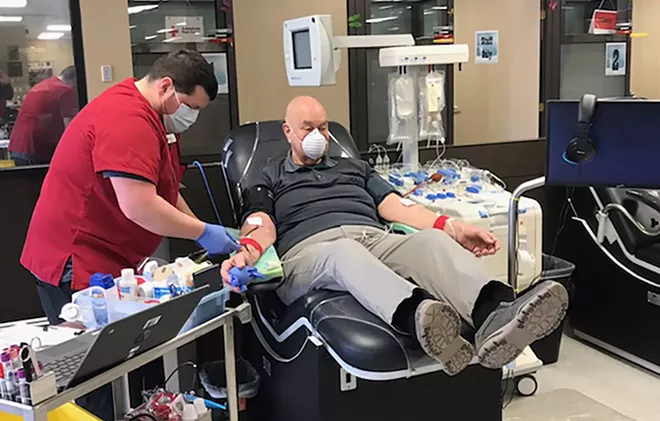
Photograph courtesy American Red Cantankerous
After being ane of the first patients in Madison, Wisconsin, to be diagnosed with COVID-19, Gary Dalgaard, 75, became the outset convalescent plasma donor in his expanse. He is shown here donating on April 10 at the American Blood-red Cross in Madison.
While ARC does not exam for COVID-nineteen, all claret donations are screened for the antibodies, and donors are informed if antibodies are nowadays. Data is bearding, merely wellness organizations receive data on the number of positive and negative tests for antibodies, which helps give a clearer picture of the extent of COVID-19 spread in communities.
According to McGuire, the Red Cross was approached by the U.S. Food and Drug Administration to create a system to collect ambulatory plasma, which is plasma from donors who take a confirmed diagnosis for COVID-19 and have been free of symptoms for 28 days.
"We're all about helping people," McGuire said. "We turned the concept into a process in a very curt time. The ARC actually stepped upwards, and in a month, we had it ready."
While no studies have definitively shown that ambulatory plasma is a cure, there take been positive initial signs in hospitals where convalescent plasma has been used to care for COVID-19 patients. Ambulatory plasma can be frozen for up to a year, and its use every bit a therapy assists the ongoing studies and search for information related to the novel coronavirus.
Academic institutions, for-profit plasma centers and national blood organizations have at present partnered in an international effort to encourage those who have survived COVID-xix to donate plasma, with Dwayne "The Rock" Johnson serving as a spokesman.
Show me the money
The recession of 2008 brought a wave of donors to plasma centers, and it is expected that the fiscal repercussions of the COVID-nineteen pandemic will do likewise as the U.S. continues to grapple with record levels of unemployment. While the World Health Organisation has long taken a stance against compensating plasma donors, some argue this concern is outdated. Peter Jaworski, a professor of ethics at Georgetown University'southward McDonough School of Concern, makes a case that other countries should begin compensating plasma donors, specially as the demand for convalescent plasma increases and the number of donors – both paid and unpaid – has dropped off since the pandemic began ("Americans become paid to donate plasma, anybody else should too," Reason, July 2, 2020). He notes that when the Czechia legalized bounty for plasma donors in 2008, donations increased sevenfold over the next iii years, with no impact on unpaid donations.
Currently, 5% of the globe'south population provides more than half of the world's plasma, with just five countries – the U.Southward. and 4 European countries that allow plasma donors to receive payment – accounting for 90% of the globe's plasma. Jaworski and others believe this is not a sustainable model, pointing to COVID-nineteen as an instance of a supply chain disruption that has reduced the amount of plasma available as the need has connected to increase.
Don, a regular donor for ii years, is a stay-calm begetter in Springfield who asked that his final name not exist used due to the stigma associated with plasma donation. Don said his main bulldoze was the need for actress money until he was able to re-enter the workforce.
"It was prissy beingness able to do it more or less on my own schedule, and fit it in on a morn or afternoon when it worked best for my family. I had thought that it was something only desperate junkies do, but the people in that location donating were generally regular people," he said.
Don suggests donors bring music and a book to pass the time, as there is oft a wait if many donors are already in line upon inflow. As far as recommending plasma donation, he said, "If you need some extra money, and have the time, it's worth it."
Melissa Blevins, a erstwhile Springfield resident who now lives in Florida, previously worked in banking and real estate, but donated plasma over an 18-month catamenia while staying at home with her children. While her younger brother had donated plasma in college for beer money, Blevins had a dissimilar aim. She and her husband donated together, earning upward to $800 per month and using the extra income to pay off debts and pay for sports programs for their kids that they couldn't otherwise afford.
Her personal finance blog, perfectionhangover.com, features a variety of suggestions for women who are seeking actress income, either to supplement or replace employment outside the dwelling house, including a documentation of her ain plasma donation feel. Though she's now been able to supplant her plasma donations with monetized blogging and YouTube videos, Blevins recommends plasma donation.
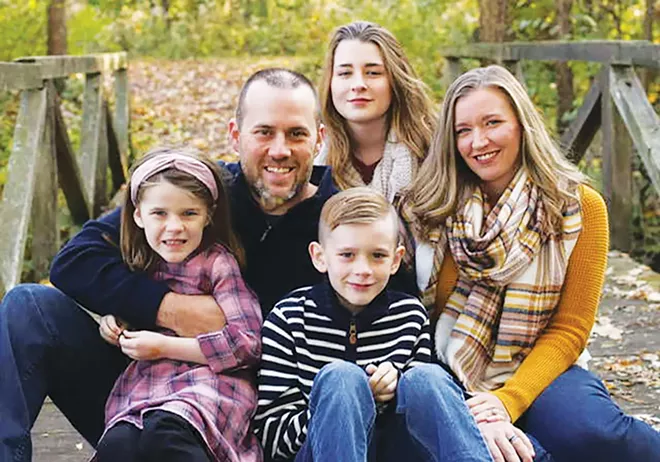
Photo by Amy Joy Photography
Melissa Blevins left the corporate world to stay at home with her children and grow her personal finance web log. She and her husband both donated plasma regularly to supplement their family unit's income.
"For someone who is digging through the couch cushions to find money for their adjacent repast, or has massive debt, or simply wants to take a footling actress money to fund their child's sports program needs or to salvage for a vacation, plasma donation is a skillful mode to go," she said.
Blevins admits she did experience out of place in the plasma center, but says she constitute out that near of the staff donated besides. "They'll stay after their shift, or come in early. I think it's and so the people who donate will see that it's and so safe and recommended that even the staff do information technology."
She did experience feeling tired or weak after donation, and Blevins said she found she had to get her cardio workout in prior to donating. She also still has puncture scarring on her artillery from the needles, despite switching donation artillery on every visit. "I look like a drug addict," Blevins said, even later on ii-and-half years of not donating.
"I withal recommend it, though. Yous have to overlook the stigma and the negative comments. You're saving lives past donating plasma. You're earning extra money for what's important to you lot. Information technology's worth it."
Carey Smith is a Springfield mother and gardener with a keen interest in the issues of poverty.
Source: https://www.illinoistimes.com/springfield/blood-money/Content?oid=12399712
Posted by: clevengertinur1961.blogspot.com
0 Response to "How Much Money Is Received When Donating At Csl Plasma In Greece Ny"
Post a Comment