

How Much Money Does The Government Spend Per Student To Attend School In Zimbabwe


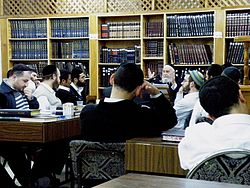

A yeshiva (; Hebrew: ישיבה, lit.'sitting'; pl. ישיבות , yeshivot or yeshivos ) is a traditional Jewish educational institution focused on the study of Rabbinic literature, primarily the Talmud and halacha (Jewish law), while Torah and Jewish philosophy are studied in parallel. The studying is usually done through daily shiurim (lectures or classes) also equally in study pairs called chavrusas (Aramaic for 'friendship'[1] or 'companionship'[2]). Chavrusa-style learning is i of the unique features of the yeshiva.
In the United States and Israel, the different levels of yeshiva education have different names. In the United states, elementary-school students are enrolled in a cheder, post-bar mitzvah-age students learn in a metivta, and undergraduate-level students learn in a beit midrash or yeshiva gedola (Hebrew: ישיבה גדולה, lit.'large yeshiva' or 'great yeshiva'). In Israel, elementary-school students are enrolled in a Talmud Torah or cheder, post-bar mitzvah-historic period students acquire in a yeshiva ketana (Hebrew: ישיבה קטנה, lit.'small yeshiva' or 'pocket-size yeshiva'), and high-schoolhouse-age students learn in a yeshiva gedola.[iii] [4] A kollel is a yeshiva for married men. It is common for a kollel to pay a token stipend to its students. Students of Lithuanian and Hasidic yeshivot gedolot (plural of yeshiva gedola) ordinarily learn in yeshiva until they get married.
Historically, yeshivas were attended by males simply. Today, all non-Orthodox yeshivas are open to females. Although there are dissever schools for Orthodox women and girls,[5] (midrasha or "seminary") these do not follow the same structure or curriculum every bit the traditional yeshiva for boys and men.
Etymology [edit]
Alternating spellings and names include yeshivah (; Hebrew: ישיבה, sitting (northward.); metivta and mesivta (Aramaic: מתיבתא methivta); beth midrash; Talmudical university, rabbinical university and rabbinical school. The word yeshiva is applied to the activity of learning in class, and hence to a learning "session."[6]
The transference in pregnant of the term from the learning session to the institution itself appears to have occurred by the time of the great Talmudic Academies in Babylonia, Sura and Pumbedita, which were known equally shte ha-yeshivot (the ii colleges).
History [edit]
Origins [edit]
The Mishnah tractate Megillah mentions the law that a town can only exist called a "metropolis" if information technology supports ten men (batlanim) to make up the required quorum for communal prayers. Too, every beth din ("house of judgement") was attended by a number of pupils up to three times the size of the courtroom (Mishnah, tractate Sanhedrin). These might be indications of the historicity of the classical yeshiva. As indicated by the Talmud,[seven] adults generally took off two months a year, Elul and Adar, the months preceding the pilgrimage festivals of Sukkot and Pesach, called Yarḥei Kalla (Aramaic for "Months of Kallah") to study. The rest of the twelvemonth, they worked.
Geonic Period [edit]

The Geonic period takes its name from Gaon, the title bestowed on the heads of the 3 yeshivas in existence from the tertiary to the thirteenth century. The Geonim acted as the principals of their individual yeshivot, and as spiritual leaders and high judges for the wider communities tied to them. The yeshiva conducted all official business concern in the name of its Gaon, and all correspondence to or from the yeshiva was addressed directly to the Gaon.
Throughout the Geonic Menstruum in that location were three yeshivot. These were named for the cities in which they were located: Jerusalem, Sura, and Pumbedita; the yeshiva of Jerusalem would later relocate to Cairo, and the yeshivot of Sura and Pumbedita to Baghdad, just retain their original names. Each Jewish community would acquaintance itself with one of the three yeshivot; Jews living around the Mediterranean typically followed the yeshiva in Jerusalem, while those living in the Arabian Peninsula and modern-twenty-four hour period Republic of iraq and Islamic republic of iran typically followed one of the two yeshivot in Baghdad. There was however, no requirement for this, and each community could choose to acquaintance with any of the yeshivot.
The yeshiva served as the highest educational institution for the Rabbis of this menstruum. In addition to this, the yeshiva wielded immense power equally the principal torso for interpreting Jewish constabulary. In this regard, the customs saw the Gaon of a yeshiva as the highest gauge on all matters of Jewish law. Each yeshiva ruled differently on matters of ritual and constabulary; the other yeshivot accepted these divisions, and all three ranked as equally orthodox. The yeshiva as well served as an administrative potency, in conjunction with local communities, by appointing members to serve as the caput of local congregations. Those appointed as the head of a congregation would serve every bit a go-between for the local congregation and the larger yeshiva information technology was fastened to. These local leaders would also submit questions to the yeshiva to obtain final rulings on bug of dogma, ritual, or law. Each congregation was expected to follow only 1 yeshiva to prevent conflict with different rulings issued by dissimilar yeshivot.
The yeshivot were financially supported through a number of ways. There were fixed, simply voluntary, yearly contributions made to the yeshivas; these almanac contributions were collected and handled past the local leaders appointed past the yeshiva. Private gifts and donations from individuals were also common, peculiarly during holidays, and could consist of money or goods.
The yeshiva of Jerusalem was finally forced into exile in Cairo in 1127, and eventually dispersed entirely. Also, the yeshivot of Sura and Pumbedita were dispersed following the Mongol invasions of the 13th century. Subsequently the handful of the yeshiva, pedagogy in Jewish religious studies became the responsibleness of individual synagogues. No system ever came to replace the iii great yeshivot of Jerusalem, Sura and Pumbedita.[viii]
Mail service-Geonic Period to the 19th century [edit]
After the Geonic Menstruation Jews went on to establishing more Yeshiva academies in Europe and in Northern Africa. I of these include the Kairuan yeshiva in Tunisia (Hebrew: ישיבת קאירואן) that was established by Chushiel Ben Elchanan (Hebrew: חושיאל בן אלחנן) in 974.[9]
Traditionally, every town rabbi had the right to maintain a number of total-fourth dimension or part-fourth dimension pupils in the town'southward beth midrash (written report hall), which was normally next to the synagogue. Their cost of living was covered by customs revenue enhancement. Subsequently a number of years, the students who received semikha (rabbinical ordination) would either accept up a vacant rabbinical position elsewhere or join the workforce.
Lithuanian yeshivas [edit]
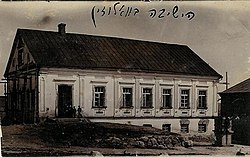
Volozhin yeshiva, "mother of the yeshivas"

Organised Torah study was revolutionised by Chaim Volozhin, an influential 18th-century Lithuanian leader of Judaism and disciple of the Vilna Gaon. In his view, the traditional arrangement did not cater to those who were looking for more intensive study.
With the support of his teacher, Volozhin gathered many interested students and started a yeshiva in the town of Valozhyn, located in modern-mean solar day Republic of belarus. The Volozhin yeshiva was closed some threescore years later in 1892 due to the Russian government'south demands for the introduction of certain secular studies.[10] Thereafter, a number of yeshivot opened in other towns and cities, most notably Slabodka, Panevėžys, Mir, Brisk, and Telz. Many prominent gimmicky yeshivot in the U.s.a. and State of israel are continuations of these institutions, and often bear the same name.
In the 19th century, Israel Salanter initiated the Mussar movement in non-Hasidic Lithuanian Jewry, which sought to encourage yeshiva students and the wider community to spend regular times devoted to the study of Jewish ethical works. Concerned past the new social and religious changes of the Haskalah (the Jewish Enlightenment), and other emerging political ideologies (such as Zionism) that frequently opposed traditional Judaism, the masters of Mussar saw a need to augment Talmudic study with more personal works. These comprised earlier archetype Jewish upstanding texts (mussar literature), besides every bit a new literature for the movement. Past focusing the pupil on self-understanding and introspection, often with profound psychological insight, the spiritual aims of Judaism could be internalized.[11] After early opposition, the Lithuanian yeshiva globe saw the demand for this new component in their curriculum, and ready aside times for private mussar study and mussar talks ("mussar shmues"). A mashgiach ruchani (spiritual mentor) encouraged the personal development of each student. To some degree, this Lithuanian movement arose in response, and as an alternative, to the separate mystical study of the Hasidic Judaism world. Hasidism began in the previous century within traditional Jewish life in Ukraine, and spread to Hungary, Poland and Russian federation. Every bit the 19th Century brought upheavals and threats to traditional Judaism, the Mussar teachers saw the benefit of the new spiritual focus in Hasidism, and adult their alternative ethical arroyo to spirituality.
Some variety adult within Lithuanian yeshivas to methods of studying Talmud and mussar, for case whether the accent would be placed on beki'ut (breadth) or iyyun (depth). Pilpul, a type of in-depth analytical and casuistic argumentation popular from the 16th to 18th centuries that was traditionally reserved for the profound nuances of investigative Talmudic written report, was not ever given a place. The new analytical approach of the Brisker method, developed by Chaim Soloveitchik, has become widely popular; all the same, there are other approaches such as those of Mir, Chofetz Chaim, and Telz. In mussar, different schools developed, such as Slabodka and Novhardok, though today, a decline in devoted spiritual self-development from its before intensity has to some extent levelled out the differences.
Hasidic yeshivas [edit]

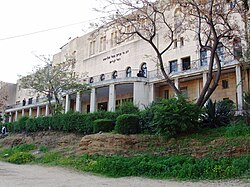
Chachmei Lublin Yeshiva, now a national monument


Bobov Kollel in Jerusalem
With the success of the yeshiva institution in Lithuanian Jewry, the Hasidic earth adult their own yeshivas, in their areas of Eastern Europe. These comprised the traditional Jewish focus on Talmudic literature that is central to Rabbinic Judaism, augmented by study of Hasidic philosophy (Hasidism). Examples of these Hasidic yeshivas are the Chabad Lubavitch yeshiva organization of Tomchei Temimim, founded by Sholom Dovber Schneersohn in Russia in 1897, and the Chachmei Lublin Yeshiva established in Poland in 1930 past Meir Shapiro, who is renowned in both Hasidic and Lithuanian Jewish circles for initiating the Daf Yomi daily cycle of Talmud written report. (For contemporary yeshivas, see, for example, under Satmar, Belz, Bobov, Breslov and Pupa.)
In many Hasidic yeshivas, study of Hasidic texts is a secondary action, similar to the additional mussar curriculum in Lithuanian yeshivas. These paths see Hasidism as a ways to the end of inspiring emotional devekut (spiritual attachment to God) and mystical enthusiasm. In this context, the personal pilgrimage of a Hasid to his Rebbe is a central characteristic of spiritual life, in order to awaken spiritual fervour. Often, such paths volition reserve the Shabbat in the yeshiva for the sweeter teachings of the classic texts of Hasidism.
In contrast, Chabad and Breslov, in their different means, identify daily report of their dynasties' Hasidic texts in central focus; come across below. Illustrative of this is Sholom Dovber Schneersohn's wish in establishing the Chabad yeshiva arrangement, that the students should spend a part of the daily curriculum learning Chabad Hasidic texts "with pilpul". The idea to learn Hasidic mystical texts with similar logical profundity, derives from the unique arroyo in the works of the Rebbes of Chabad, initiated past its founder Schneur Zalman of Liadi, to systematically investigate and clear the "Torah of the Baal Shem Tov" in intellectual forms. Further illustrative of this is the differentiation in Chabad idea (such as the "Tract on Ecstasy" past Dovber Schneuri) between general Hasidism's emphasis on emotional enthusiasm and the Chabad ideal of intellectually reserved ecstasy. In the Breslov movement, in contrast, the daily study of works from the imaginative, creative radicalism of Nachman of Breslov awakens the necessary soulfulness with which to arroyo other Jewish study and observance.
Sephardi yeshivas [edit]
- See: Category:Sephardic yeshivas, as well the more than consummate, קטגוריה:ישיבות ספרדיות

Geula branch of Porat Yosef Yeshiva.

Although the yeshiva as an institution is in some ways a continuation of the Talmudic Academies in Babylonia, big scale educational institutions of this kind were not characteristic of the Due north African and Heart Eastern Sephardi Jewish world in pre-mod times: education typically took place in a more informal setting in the synagogue or in the entourage of a famous rabbi. In medieval Spain, and immediately following the expulsion in 1492, there were some schools which combined Jewish studies with sciences such as logic and astronomy, similar to the gimmicky Islamic madrasas. In 19th-century Jerusalem, a college was typically an endowment for supporting x adult scholars rather than an educational institution in the modernistic sense; towards the end of the century a school for orphans was founded providing for some rabbinic studies.[12] Early educational institutions on the European model were Midrash Bet Zilkha founded in 1870s Republic of iraq and Porat Yosef Yeshiva founded in Jerusalem in 1914. Also notable is the Bet El yeshiva founded in 1737 in Jerusalem for avant-garde Kabbalistic studies. Afterward Sephardic yeshivot are commonly on the model either of Porat Yosef or of the Ashkenazi institutions.
The Sephardic world has traditionally placed the study of Kabbalah (esoteric Jewish mysticism) in a more mainstream position than in the European Ashkenazi world. This difference of emphasis arose in reaction to the historical events of the Sabbatean heresy in the 17th Century, that suppressed widespread study of Kabbalah in Europe in favour of the strength of Rabbinic Talmudic written report. In Eastern European Lithuanian life, Kabbalah was reserved for an intellectual elite, while the mystical revival of Hasidism articulated Kabbalistic theology through Hasidic thought. These factors did not affect the Sephardi Jewish earth, which retained a wider connectedness to Kabbalah in its traditionally observant communities. With the establishment of Sephardi yeshivas in State of israel later on the immigration of the Arabic Jewish communities there, some Sephardi yeshivas incorporated study of more attainable Kabbalistic texts into their curriculum. Yet, the European prescriptions to reserve advanced Kabbalistic study to mature and aristocracy students also influence the choice of texts in such yeshivas.
19th century to present [edit]
Conservative motion yeshivas [edit]

In 1854, the Jewish Theological Seminary of Breslau was founded. It was headed past Zecharias Frankel, and was viewed as the first educational institution associated with "positive-historical Judaism", the predecessor of Conservative Judaism. In subsequent years, Conservative Judaism established a number of other institutions of higher learning (such every bit the Jewish Theological Seminary of America in New York City) that emulate the mode of traditional yeshivas in significant ways. Even so, many do not officially refer to themselves equally "yeshivas" (one exception is the Conservative Yeshiva in Jerusalem), and all are open to both women and men, who study in the same classrooms and follow the same curriculum. Students may study function-fourth dimension, as in a kollel, or full-time, and they may study lishmah (for the sake of studying itself) or towards earning rabbinic ordination.
Nondenominational or mixed yeshivas [edit]
Non-denominational yeshivas and kollels with connections to Conservative Judaism include Yeshivat Hadar in New York, the leaders of whom include Rabbinical Assembly members Elie Kaunfer and Shai Held. The rabbinical schoolhouse of the Academy for Jewish Religion in California (AJR-CA) is led by Conservative rabbi Mel Gottlieb. The faculty of the Academy for Jewish Religion in New York and of the Rabbinical School of Hebrew College in Newton Middle, Massachusetts also includes many Bourgeois rabbis. See also Institute of Traditional Judaism.
More recently established [13] [fourteen] [15] are several non-traditional, and nondenominational (also called "transdenominational" or "postdenominational") seminaries. These grant semikha with lesser requirements re fourth dimension, and with a modified curriculum, generally focusing on leadership and pastoral roles. These are JSLI, RSI and PRS. The Wolkowisk Mesifta is aimed at community professionals with significant knowledge and experience, and provides a tailored program to each candidate. Rimmon, the almost recently established, emphasizes halakhic determination making. Come across nether § Curriculum for further discussion.
Reform and Reconstructionist seminaries [edit]

Reconstructionist Rabbinical College
Hebrew Union Higher (HUC), affiliated with Reform Judaism, was founded in 1875 under the leadership of Isaac Mayer Wise in Cincinnati, Ohio. HUC later opened additional locations in New York, Los Angeles, and Jerusalem. Information technology is a rabbinical seminary or higher more often than not geared for the preparation of rabbis and clergy specifically. Similarly, the Reconstructionist Rabbinical College of Reconstructionist Judaism, founded in Pennsylvania in 1968, functions to train its hereafter clergy. Some Reform and Reconstructionist teachers also teach at the not-denominational seminaries mentioned above. In Europe, Reform Judaism trains rabbis at Leo Baeck College in London, Uk and Abraham Geiger Kolleg in Potsdam, Germany. None of these institutions describes itself equally a "yeshiva".
Contemporary Orthodox yeshivas [edit]


World War II and the Holocaust brought the yeshivot of Eastern and Central Europe to an cease – even so many scholars and rabbinic students who were able to escape the war, established yeshivot in a number of Western countries which had no or few yeshivot.[xviii] (The Yeshiva of Nitra was the last surviving in occupied Europe. Many students and faculty of the Mir Yeshiva were able to escape to Siberia, with the Yeshiva ultimately continuing to operate in Shanghai. Encounter Yeshivas in World War II.)
From the mid-20th century [18] the greatest number of yeshivot, and the near important of them, was centered in Israel and in the United States; but they were as well found in many other Western countries, prominent examples are Gateshead Yeshiva in England (i of the descendants of Novardok) and the Yeshiva of Aix-les-Bains, France. The Chabad motility was particularly agile in this direction,[xviii] establishing yeshivot also in French republic, North Africa, Australia, and South Africa; this "network of institutions" is known as Tomchei Temimim.
As mentioned, many prominent contemporary yeshivot in the Usa and Israel are continuations of European institutions, and often bear the same proper name.
State of israel [edit]
- Run across: Category:Orthodox yeshivas in Israel, Category:Religious Zionist yeshivot.
Yeshivot in Israel have operated since Talmudic times;[19] come across Talmudic academies in Eretz Yisrael. Notable more than recent examples include the Ari Ashkenazi Synagogue (since the mid 1500s); the Bet El yeshiva (operating since 1737); and Etz Chaim Yeshiva (since 1841). Various yeshivot were established in Israel in the early 20th century. Shaar Hashamayim was established in 1906, Chabad's Toras Emes in 1911, Hebron Yeshiva in 1924, Sfas Emes in 1925, Lomza in 1926. Subsequently (and during) Earth War Two, numerous other Haredi and Hasidic Yeshivot were re-established in that location by survivors. The Mir Yeshiva in Jerusalem – today the largest Yeshiva in the world – was established in 1944, by Rabbi Eliezer Yehuda Finkel who had traveled to Palestine to obtain visas for his students. Porat Yosef, the leading Sephardi Yeshiva, was founded in 1914; its predecessor, Yeshivat Ohel Moed was founded in 1904. From the 1940s and onward, especially following immigration of the Arabic Jewish communities, Sephardi leaders, such as Ovadia Yosef and Ben-Zion Meir Hai Uziel, established various yeshivot to facilitate Torah educational activity for Sephardi and Mizrahi Jews (and alternative to Lithuanian yeshivot).
The Haredi customs has grown with time – In 2016, 9% of Israel's population was Haredi, including Sephardic Haredim – supporting many yeshivot correspondingly (run into Israel#Religion). Boys and girls here nourish separate schools, and proceed to higher Torah study, in a yeshiva or seminary, respectively, starting anywhere between the ages of 13 and 18; meet Chinuch Atzmai and Bais Yaakov. A meaning proportion of young men and so remain in yeshiva until their marriage; thereafter many go along their Torah studies in a kollel. (In 2006, in that location were 80,000 in total-fourth dimension learning .[18]) Kollel studies normally focus on deep analysis of Talmud, and those Tractates not ordinarily covered in the standard "undergraduate" program; meet #Talmud written report beneath. Some Kollels similarly focus on halacha in total, others specifically on those topics required for Semikha (Rabbinic ordination) or Dayanut (qualification equally a Rabbinic Judge). The certification in question is often conferred by the Rosh Yeshiva.
Mercaz Harav, the foundational and leading Religious-Zionist yeshiva was established in 1924 by Ashkenazi Chief Rabbi Abraham Isaac Kook. Many in the Religious Zionist community today attend a Hesder yeshiva (discussed below) during their national service; these offer a kollel for Rabbinical students. (Students by and large prepare for the Semikha examination of the Master Rabbinate of Israel; until his contempo passing (2020) commonly for that of the posek R. Zalman Nechemia Goldberg.) Grooming as a Dayan in this community is usually through Machon Ariel (Machon Harry Fischel), also founded past Rav Kook, or Kollel Eretz Hemda. Women in this customs, every bit above, report in a Midrasha. High school students study at Mamlachti dati schools, ofttimes associated with Bnei Akiva. Bar Ilan Academy allows students to combine Yeshiva studies with university study; Jerusalem College of Technology similarly, which also offers a Haredi rail; there are several colleges of education associated with Hesder and the Midrashot (these often offer specializations in Tanakh and Machshavah – see below). See Religious Zionism#Educational institutions.
United States [edit]
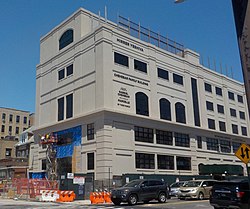
- See: Category:Orthodox yeshivas in the United States.
The first Orthodox yeshiva in the United States was Etz Chaim of New York (1886), modeled after Volozhin. Information technology developed into the Rabbi Isaac Elchanan Theological Seminary (1896; "RIETS") and eventually Yeshiva Academy in 1945. It was established in the wake of the immigration of Primal and Eastern European Jews (1880s – 1924). Mesivtha Tifereth Jerusalem, founded in 1907, was led by Rabbi Moshe Feinstein from the 1940s through 1986; Yeshiva Rabbi Chaim Berlin, est 1904, was headed by Rabbi Yitzchok Hutner from 1943 to 1980. Many Hasidic dynasties accept their principal Yeshivot in America, typically established in the 1940s; the Primal Lubavitcher Yeshiva has over thousand students.
The postwar establishment of Ashkenazi yeshivot and kollelim parallels that in Israel; equally does the educational pattern in the American Haredi community, although more obtain a secular education at the higher level (run into College credit below). Beth Medrash Govoha in Lakewood, New Jersey with iii,000 students in the early 2000s was founded in 1943 by R. Aaron Kotler on the "rigid Lithuanian model" that demanded total-time study;[18] information technology now offers a Bachelor of Talmudic Law degree which allows students to go on to graduate school.[20] [18] The best known of the numerous Haredi yeshivas are "Lakewood", Telz, "Rabbinical Seminary of America", Ner Yisroel, Chaim Berlin, and Hebrew Theological College; Yeshivish (i.e. satellite) communities frequently maintain a community kollel. Many Hasidic sects have their own yeshivas - see especially Satmar and Bobov - while Chabad, as mentioned, operates its Tomchei Temimim nationwide. Regarding junior and high school - of which there are over 600 combined - see Torah Umesorah, Mesivta, and Bais Yaakov.
Modern Orthodox typically spend a year, often ii, mail service-loftier schoolhouse in a yeshiva (sometimes Hesder) or Midrasha in State of israel. Many thereafter, or instead, attend Yeshiva University, undertaking a dual curriculum, combining bookish teaching with Torah study;[21] run across Torah Umadda and South. Daniel Abraham Israel Program. (A pct stay in Israel, "making Aliyah"; many also go on to higher education in other American colleges.) Semikha is usually through RIETS, although many Modern Orthodox Rabbis study through Hesder, or other Yeshivot in Israel such as Yeshivat HaMivtar, Mizrachi's Musmachim program,[22] and Machon Ariel.[23] RIETS likewise houses several post-semikha kollelim, including ane focused on Dayanut.[24] Dayanim also train through Kollel Eretz Hemda[25] and Machon Ariel; while Mizrachi's post-semikha Manhigut Toranit programme[26] focuses on leadership and scholarship, with the advanced semikha of "Rav Ir". Communities will ofttimes host a Torah MiTzion kollel, where Hesder graduates acquire and teach, generally for 1 yr. At that place are numerous Modernistic Orthodox Jewish mean solar day schools, typically offer a beit midrash / metivta programme in parallel with the standard curriculum, (often) structured such that students are able to join the first shiur in an Israeli yeshiva.
The United states of america educational blueprint is to be plant around the Jewish world, with regional differences; run across Category:Orthodox yeshivas in Europe and Category:Orthodox yeshivas by country.
Construction and features [edit]
| typical daily schedule |
The following is a typical daily schedule for Beit Midrash students in mainstream Lithuanian yeshivas, although the schedule volition vary from Yeshiva to Yeshiva:[ commendation needed ]
This schedule is more often than not maintained Sunday through Th. On Thursday nights, there may be an actress long night seder, known as mishmar sometimes lasting across i:00 am, and in some yeshivot fifty-fifty until the following sunrise. On Fridays, there is usually at least ane seder in the morn, with unstructured learning schedules for the afternoon. Saturdays have a special Shabbat schedule which includes some sedarim only usually no shiur. |

Yeshiva study is differentiated from, for example university report, as regards several structural features – curriculum aside. The year is structured into "zmanim"; the mean solar day is structured into "seders". The learning itself is delivered through a "shiur", a lecture with pre-specified sources, or "marei mekomot" (מראה מקומות; "bibliography", lit. "indication of the (textual) locations");[27] [28] study in general, and especially the preparation for shiur, takes place in "chavruta" or paired-study. This study is in a mutual venue called the bet midrash (Yiddish, "zal" i.e. "hall").
The establishment is headed by its rosh yeshiva, while other senior rabbis are referred to as "Ram" (rosh mesivta or reish metivta); the mashgiach assumes responsibleness for students' spiritual development (mashpia, in Hasidic yeshivot). A kollel is headed past its rosh kollel, fifty-fifty when information technology is part of a yeshiva. A sho'el u'meishiv (Hebrew: שואל ומשיב; lit. transl. ask and he answers; often simply "meishiv", or alternately "nosay five'notayn") is usually available to consult to students on difficult points in their day's Talmudic studies. The rabbi responsible for the Talmudic shiur is known as a maggid shiur. Students are known as talmidim (sing. talmid). Rav muvhak is sometimes used in reference to ane'due south primary teacher; correspondingly, talmid muvhak may refer to a master, or outstanding, student.
Academic year [edit]
In most yeshivot, the yr is divided into iii periods (terms) called zmanim (lit. times; sing. zman). Elul zman starts from the showtime of the Hebrew month of Elul and extends until the end of Yom Kippur. The six-weeks-long semester is the shortest yet most intense session, as it comes before the Loftier Holidays of Rosh Hashanah and Yom Kippur. Winter zman starts later Sukkot and lasts until virtually two weeks before Passover, a duration of five months (six in a Jewish leap twelvemonth). Summer zman starts after Passover and lasts until Rosh Chodesh Av or Tisha B'Av, a duration of about 3 months.
Chavruta-mode learning [edit]
Yeshiva students gear up for and review the shiur (lecture) with their chavruta during a study session known every bit a seder.[two] In contrast to conventional classroom learning, in which a teacher lectures to the pupil and the student repeats the information back in tests, chavruta-style learning challenges the student to analyze and explain the material, point out the errors in his partner's reasoning, and question and sharpen each other's ideas, often arriving at entirely new insights of the meaning of the text.[one] [29] A chavruta helps a educatee keep his mind focused on the learning, acuminate his reasoning powers, develop his thoughts into words, organize his thoughts into logical arguments, and understand some other person'south viewpoint.[xxx] The shiur-based system was innovated at the Telshe yeshiva, where there were five levels.
Chavruta-style learning tends to be loud and animated, as the study partners read the Talmudic text and the commentaries aloud to each other, and so analyze, question, fence, and even argue their points of view to arrive at an understanding of the text. In the heat of discussion, they may even wave their easily, pound the table, or shout at each other.[31] Depending on the size of the yeshiva, dozens or even hundreds of pairs of chavrutas can be heard discussing and debating each other's viewpoints.[32] 1 of the skills of chavruta-style learning is the power to block out all other discussions in the study hall and focus on 1's chavruta alone.[ii]
Types of yeshivot [edit]

Talmud Torah, Russia, 1937

Yeshiva High School, Tel Aviv, 1938

"Cheder"-class in Talmud, Tel Aviv, 1946.

Bet Midrash, Yeshivat Kerem B'Yavneh
- Yeshiva Ketana (junior yeshiva) or "Talmud Torah" – Many Haredi (non-Hasidic and Hasidic) yeshivot ketanot in State of israel, and some (primarily Hasidic) in the Diaspora, do not have a secular form of studies,[ citation needed ] with all students learning Judaic Torah studies full-fourth dimension.
- Yeshiva Loftier Schoolhouse – also called Mesivta (Metivta) or Mechina or Yeshiva Ketana, or in Israel, Yeshiva Tichonit [33] – combines the intensive Jewish religious education with a secular high school pedagogy. The dual curriculum was pioneered by the Manhattan Talmudical Academy of Yeshiva Academy (at present known equally Marsha Stern Talmudical Academy) in 1916; ALMA was established in Jerusalem in 1936, and "ha-Yishuv" in Tel Aviv in 1937.
- Mechina – For Israeli high-school graduates who wish to report for ane year before entering the army. In Telshe yeshivas and in Ner Yisroel of Baltimore, the Mesivtas/Yeshiva ketanas are known as Mechinas.
- Beth midrash – For high school graduates, and is attended from one yr to many years, dependent on the career plans and affiliation of the student.
- Yeshivat Hesder – Yeshiva that has an arrangement with the Israel Defense Forces past which the students enlist together in the same unit and, as much as is possible serve in the same unit of measurement in the army. Over a period of most v years there will be a flow of service starting in the second year of virtually 16 months. At that place are dissimilar variations. The residual of the time will be spent in compulsory study in the yeshiva. The Hesder Yeshiva concept is attributed to Rav Yehuda Amital. The showtime was Yeshivat Kerem B'Yavneh, established in 1954; the largest is the Hesder Yeshiva of Sderot with over 800 students.
- Kollel – Yeshiva for married men. The kollel idea has its intellectual roots in the Torah; Mishnah tractate Megillah mentions the law that a town tin can only be called a "metropolis" if it supports ten men (batlanim) to make upward the required quorum for communal learning. All the same, it is more often than not a modernistic innovation of 19th-century Europe. A kollel will ofttimes exist in the aforementioned location every bit the yeshiva.
- Baal Teshuva yeshivot catering to the needs of the newly Orthodox.
Postal service-high schools for women are by and large called "seminary", or midrasha in State of israel, [34] and not yeshiva. (Although there are exceptions such every bit Prospect Park Yeshiva.) The Haredi Bais Yaakov organisation was started in 1918 nether the guidance of Sarah Schenirer. These institutions provide girls with a Torah education, using a curriculum that skews more toward applied halakha (Jewish law) and the study of Tanakh, rather than Talmud. The curriculum at Religious Zionist and Modern Orthodox midrashot, nevertheless, often includes some study of Talmud: often Mishnah, sometimes Gemara; in farther stardom, curricula by and large entail Chavruta-based study of the texts of Jewish philosophy, and also Tanakh is studied with commentaries. See Midrasha#Curriculum for further discussion.
Languages [edit]
Classes in virtually Lithuanian and Hasidic yeshivot (throughout the globe) are taught in Yiddish; Kol Torah, est 1939 in Jerusalem and headed past Shlomo Zalman Auerbach for over 40 years, was the first mainstream Haredi yeshiva to teach in Hebrew, as opposed to Yiddish. Sephardi, Mod Orthodox, Zionist, and baal teshuvah yeshivot apply Mod Hebrew or the local language.
Students learn with each other in whatever linguistic communication they are most expert, with Hasidic students usually learning in Yiddish, Israeli Lithuanian students in Hebrew, and American Lithuanian students in English.
College credit [edit]
Although often non encouraged, some yeshivas permit students to attend college on a limited basis. This concession is facilitated by arrangements for the student to receive credit towards a college caste.[35] Yeshiva University in New York provides a year's worth of credit for yeshiva studies.[36] Haredi institutions with similar arrangements in place include Lander College for Men, Yeshivas Ner Yisroel and Hebrew Theological College.
Every bit above, some American yeshivot in fact award the degrees Bachelor of Talmudic Police (4 years cumulative study), Master of Rabbinic Studies / Chief of Talmudic Law (half-dozen years), and (at Ner Yisroel) the Doctorate in Talmudic Law (ten years). These degrees are nationally accredited past the Association of Advanced Rabbinical and Talmudic Schools, and may then grant access to graduate programs such equally police school.
For historical context meet: Hildesheimer Rabbinical Seminary; Moses Sofer § Influence confronting changes in Judaism; Volozhin yeshiva § History; Telshe Yeshiva § History; Vilna Rabbinical Schoolhouse and Teachers' Seminary; Yitzchok Hutner § Rabbinic and instruction career; Mesivta § Modernistic-day concept; Midrasha § Certifications; Torah Lehranstalt § History; Kelm Talmud Torah; Jewish didactics § Secular instruction emphasis
Curriculum [edit]
Torah study at an Orthodox yeshiva comprises the report of rabbinic literature, principally the Talmud, along with the study of halacha (Jewish law); Musar and Hasidic philosophy are ofttimes studied also.[xi] In some institutions, classical Jewish philosophy or Kabbalah are formally studied, or the works of individual thinkers (such equally Abraham Isaac Kook).
Non-Orthodox institutions offer a synthesis of traditional and critical methods, assuasive Jewish texts and tradition to encounter social change and modern scholarship. The curriculum is thus likewise focused on classical Jewish subjects - Talmud, Tanakh, Midrash, halacha, and Philosophy - just differs from Orthodox yeshivot in that the bailiwick-weights are more fifty-fifty (correspondingly, Talmud and halacha are less emphasized), and the approach entails an openness to modern scholarship; the curriculum also emphasizes "the other functions of a modernistic rabbi such as preaching, counseling, and pastoral work".[37] Note that every bit mentioned, oft, in these institutions less accent is placed on Talmud and Jewish law, "but rather on sociology, cultural studies, and modern Jewish philosophy".[38]
Bourgeois Yeshivot occupy a position midway,[38] in that their training places (significantly) more accent on Halakha and Talmud than other non-Orthodox programs; meet Conservative halakha.
The beneath sections discuss the Orthodox approach - merely may exist seen as overviews of the traditional-content; see also re the various approaches under List of rabbinical schools as well every bit under Rabbi § Ordination.
Talmud study [edit]

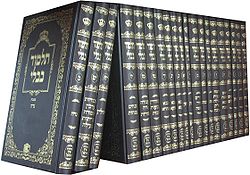
In the typical Orthodox yeshiva, the main accent is on Talmud report and analysis, or Gemara. Generally, 2 parallel Talmud streams are covered during a zman (trimester). The first is iyyun, or in-depth report (variants described beneath), frequently bars to selected legally focused tractates with an emphasis on analytical skills and shut reference to the classical commentators;[28] the 2d, beki'ut, seeks to cover ground more speedily in gild to build general knowledge of the Talmud. In some Hasidic yeshivas, girsa ("text"), is the term used for beki'ut, only may also incorporate an element of memorization.
In the yeshiva system of Talmudic report, the undergraduate yeshivot focus on eight mesechtohs (tractates) that deal with civil jurisprudence (Nezikin); through them, the student can best master the proper technique of Talmudic analysis, and [39] the halakhic awarding of Talmudic principles. With these mastered, the student is ready to go on to other areas of the Talmud[xi] (see, for case, Yeshivas Ner Yisroel #Wheel of Masechtos). Tractates Berachot, Sukkah, Pesachim and Shabbat are ofttimes included.[40] [41]
Works initially studied to analyze the Talmudic text are the commentary by Rashi, and Tosafot, a parallel analysis and running critique. The integration of Talmud, Rashi and Tosafot, is considered as foundational – and prerequisite – to farther analysis (in fact, this combination is sometimes referred to by its own acronym, "gefet" גפ״ת – Gemara, perush Rashi, Tosafot). [41] The super-commentaries past "Maharshal", "Maharam" and "Maharsha" address the three together.
At more advanced levels, additional mefarshim (commentators) are studied: other rishonim, from the 11th to 14th centuries, as well every bit acharonim, from later generations. (There are two main schools of rishonim, from France and from Spain, who will concord different interpretations and understandings of the Talmud.) At these levels, students link the Talmudic word to codified law – especially Mishneh Torah (i.e. Maimonides), Arba'ah Turim and Shulchan Aruch – past studying, also, the halakha-focused commentaries of Asher ben Jehiel, Isaac Alfasi and Mordechai ben Hillel, respectively referred to equally "Rosh", "Rif", and the "Mordechai".
As the level of the shiur progresses, so the student must integrate more of these commentaries into their analysis of the sugya (loosely, Talmudic "unit of analysis"), and empathise their various implications re practical-halakha. This iyyun will generally take one the following forms, each a "derech ha-limud" or "way of learning" (meet the Hebrew commodity "Approaches to Learning Talmud"):
- At the college levels, in many Lithuanian influenced Yeshivot, the securely analytic "Brisker method" is employed, as mentioned; the method - often referred to simply as lomdus - seeks to identify the principles underlying each commentator's approach, abstracting beyond the context of the specific sugya, by placing each inside a categorical structure.
- Elsewhere, and generally, the approach is more traditional: students work through each sugya in lite of the various rishonim, successively specifying and understanding - and if possible, reconciling - differences (legal and conceptual) between these; through this, the study builds and deepens the concepts and principles arising from the tractate; an important simultaneous requirement is that the "simple estimation" of the underlying sugyas must maintain.
- Many Yeshivot proceed "aliba dehilchasa" [42] (אליבא דהלכתא, Seph. pronunciation, dehilchata; lit. "co-ordinate to the Constabulary"), where the learning focuses more on the Halachik-rules that develop from the sugya, delineating how the opinions of the rishonim and acharonim chronicle to practise. There are 2 sub-approaches:[42] The first, oft the arroyo taken at Sephardic Yeshivot, analyzes the sugya as the source of the halacha, understanding how it inheres in each rishon, and is undertaken fifty-fifty for topics with limited application (prototypical are ir nidachat and ben sorer umoreh). The second, often [43] applied when the sugya is studied by semikha students - meet below - focuses on the implication re practical-halacha, the "nafka mina", of each commentary, somewhat limiting theoretical and abstruse discussion.
- Finally, some Yeshivot – such every bit Birkat Moshe – particularly emphasize the Rambam, analyzing the sugya in low-cal of the Mishneh Torah and its numerous commentaries. (Brisker yeshivot invariably reference Rambam also: the Mishneh Torah covers all of halacha, and thus provides a consequent reference for the treatment of other rishonim; meet Chiddushei Rabbeinu Chaim.)
The Rosh Yeshiva typically gives the most senior daily Talmud-shiur. Information technology is especially here that the student consolidates the yeshiva'southward approach to iyyun, i.due east. its derech ha-limud; see Rosh yeshiva § Role. The Rosh Yeshiva likewise delivers the weekly shiur klali (comprehensive lecture), which sums up the week's learning; this is attended by all levels, and will often accept its own marei mekomot.
Typically, boys brainstorm their written report of Talmud in middle school, initially studying Mishnah, the component of Talmud where the underlying "cases" are presented. (At this stage, they have completed their survey of Chumash, with these cases expanding on the legal precepts at that place; run into below.) In early loftier school, gemara, the analytic component, is introduced; by late loftier school some are able to piece of work with Tosafot. Some systems more than closely follow Pirkei Avot ch 5:21 every bit a guideline; where Mishna-study begins at historic period 10, and Gemara at 15. See Zilberman Method for further give-and-take.
Jewish law [edit]
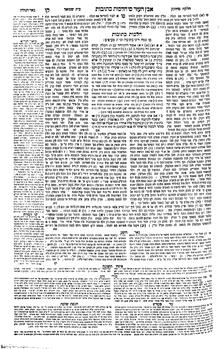

Generally, a menstruation is devoted to the study of practical halakha ("Halakha LeMaaseh"), emphasizing upshot every bit opposed to derivation. The text most commonly studied in Ashkenazi yeshivot is the Mishnah Berurah, a commentary on the Shulchan Aruch originally published between 1884 and 1907. In Sephardic yeshivot, the Shulchan Aruch itself is more commonly studied, along with the Bet Yosef commentary; the Yalkut Yosef and Kaf Hachaim are as well often studied, while Ben Ish Hai is a standard reference. In Chabad yeshivot,[44] emphasis is placed upon study of Shulchan Aruch HaRav. Beginning students are encouraged to likewise work through the Kitzur Shulchan Aruch, and so equally to survey all areas of applicable halacha and to consolidate their prior, high schoolhouse, Torah knowledge (this is also often the exercise exterior of Chabad). More advanced students, additionally and similarly, review the Mishneh Torah through its daily written report wheel (this is often outside of any seder), here including halachot relating to, for example, the Temple.
Students in Semikha (Rabbinic ordination) programs, and often those in kollel, devote the largest portion of their schedule to halakha. The focus is on in-depth, source-based[27] written report of those areas where (customs) Rabbis will typically be asked "shaylas", i.e. halachic questions; the testing [44] [45] [46] [47] invariably covers Kashrut (referred to as "Issur v'Heter"), usually Shabbat, ofttimes Niddah, sometimes Avelut (mourning) and/or spousal relationship. This study encompasses a detailed assay of the halakha in the Arba'ah Turim and Beit Yosef, through its concluding presentation in the Shulchan Aruch, with its major commentaries (especially "Shakh" and "Taz"), complemented past a survey of key She'elot u-Teshuvot (responsa), recent and historical. The analysis, in turn, requires a detailed knowledge of all relevant Talmudic sugyas, which are studied accordingly within the schedule.[39] [twoscore] Students in an Orthodox Semikha program will thus have a strong groundwork in Talmud, typically[45] having spent at least four[forty] [41] preceding years in Yeshiva; Kollel students likewise. (See Rabbi § Orthodox and Modern Orthodox Judaism and Posek § Formulating a ruling (psak din).) During the morning seder, Semikha students continue their Talmud studies, learning the aforementioned masechet every bit the rest of the Yeshiva.[47]
Ethics, mysticism and philosophy [edit]

Cover of the showtime edition of Mesillat Yesharim.
Haredi Yeshivot typically devote a seder to mussar (ethics and character development). The preeminent text studied is the Mesillat Yesharim ("Path [of the] Just") of Moshe Chaim Luzzatto. Other works of mussar literature studied include:
- Orchot Tzaddikim ("Paths [of the] Righteous"); its authorship and time of writing is uncertain, only as it quotes Maimonides, it was written some time after his works were disseminated.
- Chovot ha-Levavot ("Duties of the Hearts") by Bahya ibn Paquda.
- Ma'alot ha-Middot ("Benefit [of proficient character] traits") by Jehiel Anav
- Mishnat R' Aharon, Mussar Lectures on many topics by Aharon Kotler.
- Mikhtav me-Eliyahu, the works of Eliyahu Eliezer Dessler.
- Tomer Devorah by Moses Cordovero.
- Sichos Mussar past Chaim Leib Shmuelevitz.
- Pele Yoetz by Eliezer Papo.
- Kav ha-Yashar past Tzvi Hirsch Kaidanover.
As above, these sessions focus the student on self-understanding and introspection, internalizing the spiritual aims of Judaism, and developing the grapheme-traits, or middos, accordingly. Topics in practical Jewish ethics, such as the "laws of voice communication", are often studied separately.
Hasidic yeshivot written report the mystical, spiritual works of Hasidic philosophy (Chassidus). These describe on the before esoteric theology of Kabbalah, but articulates it in terms of inner psychological awareness and personal analogies. This study thus makes Jewish mysticism accessible and tangible, so that it inspires emotional dveikus (cleaving to God) and embeds a deep spiritual chemical element in daily Jewish life; it thereby serves a similar purpose to mussar, simply through different ways and with different contributions to intellectual and emotional life. Chabad yeshivot, for case, report the Tanya, the Likutei Torah, and the voluminous works of the Rebbes of Chabad for an hour and a half each morning, earlier prayers, and an hour and a half in the evening. See above.
As mentioned, Sephardi yeshivot often incorporate study of selected Kabbalistic texts into their curriculum – standard texts, as well as works by Yosef Hayyim, Yehuda Fatiyah and Yaakov Chaim Sofer. Kabbalistic sources are brought in halachik works such every bit Kaf Hachaim and Ben Ish Hai – run into Sephardic law and customs#Lurianic Kabbalah – and are then studied indirectly besides.
In Hesder, Religious Zionist and Modern Orthodox yeshivot, Machshavah (Jewish philosophy generalized / applied equally "Jewish idea"; besides Hashkafa, "worldview") is taught formally,[48] with classes systematically covering the major topics and works (Kuzari, Moreh Nevukhim, Sefer ha-Ikkarim , Emunot ve-Deot, Derech Hashem, Nefesh Ha-Chaim, Kad ha-Kemach and others). Hesder yeshivot additionally devote specific fourth dimension to the writings of Abraham Isaac Kook, "Rav Kook", who articulated a unique personal blend of mysticism, creative exegesis and philosophy (also every bit to Torat Eretz Yisrael generally). The Modern Orthodox, similarly, study the works of Joseph B. Soloveitchik, "Rav Soloveitchik". Hasidic philosophy and Mussar are likewise oft taught; and Maharal may have a dedicated shiur. Machshava is besides a focus-area of many Midrashot.
Some Haredi and Hasidic yeshivas also include formal study of Hashkafa, especially at ba'al teshuva focused yeshivas; many Semikha programs likewise, particularly those with an outreach, or kiruv, component. Regardless, students here typically report the major works independent of a shiur.
Torah and Bible study [edit]
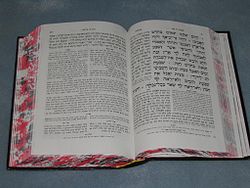
Chumash with Mikraot Gedolot

Chumash with Yiddish translation
Intensive study of Chumash (Torah) with the commentary of Rashi is stressed and taught in all simple grades.[11] In Haredi and Hasidic yeshivas, this is often washed with Yiddish translations. The rest of the Tanakh (Hebrew Bible) is usually taught through loftier school, although less intensively.
In Yeshivot, thereafter, Chumash, and especially Nach, are studied less directly. Yeshiva students typically follow the do of Shnayim mikra ve-echad targum, independently studying the upcoming parashah (weekly Torah portion) twice in the original Hebrew and once in Targum Onkelos (an Aramaic translation), with Rashi's commentary. Students oft also study Ramban'southward commentary, and, less often, other commentaries from the Mikraot Gedolot edition are reviewed. Students may similarly study the Tanakh independently, but information technology is not taught per se; exceptions are the five Megilloth and Tehillim. The Rosh Yeshiva usually delivers a weekly shiur on the parashah, exploring a particular question or theme, which is oft open to the public.
At Hesder, Religious Zionist and Modern Orthodox yeshivot, the study of Chumash and Nach continues in parallel with Talmud report. These institutions offering formal shiurim in many, if non all, of the books of Nevi'im and Ketuvim. These are oftentimes structured by level, similar to Talmud written report, where the text, and its overall structure, is and then analyzed in light of the various commentaries and Midrashim, typically complementing the Machshavah shiurim. More contempo commentaries especially studied are "Netziv" and "Malbim"; likewise every bit reference works such equally Da'at Miqra past Mordechai Breuer and others. The commentaries by Ramban and "Rav Hirsch" provide much philosophical content. (See farther re this approach nether Yeshivat Har Etzion § Educational and religious philosophy.) Intensive study of Tanakh, every bit for Machshava, is similarly a feature of many Midrashot.
See besides [edit]
- Bais Yaakov
- Jewish 24-hour interval schoolhouse
- List of rabbinical schools
- Mesivta
- Religious school
- Yeshivish
References [edit]
- ^ a b Liebersohn, Aharon (2009). Earth Broad Agora. p. 155. ISBN9781409284772.
- ^ a b c Forta, Arye (1989). Judaism. Heinemann Educational. p. 89. ISBN0-435-30321-X.
- ^ Berezovsky, Rabbi Sholom Noach (2001). נתיבות שלום [Nesivos Sholom]. Feldheim Publishers. p. 211. ISBN9781583304952.
- ^ Kramer, Doniel Zvi (1984). The Mean solar day Schools and Torah Umesorah: The Seeding of Traditional Judaism in America. Yeshiva Academy Press. p. xiv.
- ^ "Sarah Schenirer a"h, the Mother of the Bais Yaakov Movement, On Her Yahrtzeit, Today, 26 Adar". matzav.com. 2013-03-08. Retrieved 2018-10-06 .
- ^ "Session", in fact, similarly derives from the Latin sedere, "to sit."
- ^ (Where in the Talmud, and in which Talmud (Bavli or Yerushalmi?)
- ^ Goitein, Due south.D. (1999). Lassner, Jacob (ed.). A Mediterranean Society: An Abridgement in 1 Volume. Berkeley: Academy of California Press. ISBN9780520240599 . Retrieved 2018-x-06 .
- ^ מרדכי וורמברנד ובצלאל ס. רות, עם ישראל – תולדות 4000 שנה – מימי האבות ועד חוזה השלו
- ^ Schacter, Jacob J. (1990). "Haskalah, Secular Studies and the Close of the Yeshiva in Volozhin in 1892". The Torah U-Madda Journal. 2: 76–133. JSTOR 40914771.
- ^ a b c d Krakowski, Moshe (26 December 2018). "What Yeshiva Kids Are Actually Studying All Day". Forward . Retrieved 22 January 2020.
- ^ Elazar, Daniel J. "Can Sephardic Judaism be Reconstructed?". Jerusalem Middle for Public Diplomacy. Retrieved 2018-10-06 .
- ^ Rabbi Andrea Lobel (2021). A Unlike Path to Ordination, Tablet
- ^ Josh Nathan-Kazis (2012). Online-Ordained Rabbis Catch Pulpits, The Forward
- ^ Rabbi P. Beaulier (2019). Want More Diverseness In Rabbinical Schools? Then Motion Them Online, ejewishphilanthropy.com
- ^ Steve Strunsky (April 16, 2019). "Lakewood yeshiva looks to utilise old golf course for new campus". New Jersey On-Line LLC. Retrieved April 16, 2019.
Beth Medrash Gohova is said to be the world's largest Jewish-affiliated university outside of Israel.
- ^ Stephen Stirling (3 August 2017). "10 ways Lakewood is different anywhere else in North.J." NJ Accelerate Media. Retrieved April 16, 2019.
The sea change can exist pinned to i event: The founding of the Beth Medrash Govoha yeshiva in the mid-20th century. The Orthodox Jewish community has prepare downward roots en masse around the religious school, which is now the largest yeshiva in North America.
- ^ a b c d e f "Yeshiva", jewishvirtuallibrary.org
- ^ See east.g. Brachot 18b
- ^ beth-medrash-govoha on chea.org
- ^ "Mission Statement". Yeshiva University. Archived from the original on May 27, 2010. Retrieved August 27, 2010.
- ^ Musmachim mizrachi.org
- ^ Ariel Constitute
- ^ "kollellim", yu.edu/riets
- ^ Yadin-Yadin for the Diaspora, eretzhemdah.org
- ^ manhigut-toranit.org
- ^ a b Example marei mekomot - Halacha
- ^ a b Example marei mekomot - Gemara
- ^ "Bringing the People Together". Reb Jeff. 24 February 2011. Retrieved 23 June 2011.
- ^ Zobin, Zvi (1996). Breakthrough to Learning Gemora: A Curtailed, Analytical Guide. Kest-Lebovits. pp. 104–106.
- ^ Neusner, Jacob; Avery-Peck, Alan J. (2001). The Blackwell Reader in Judaism. Blackwell Publishers. p. 422. ISBN0-631-20738-4.
- ^ Finkel, Avraham Yaakov (1999). Ein Yaakov: The Ethical and Inspirational Teachings of the Talmud. Jason Aronson. p. xxix. ISBN0-7657-6082-7.
- ^ See the Hebrew Wikipedia's ישיבה תיכונית.
- ^ Midrashot, science.co.il
- ^ "Guide To Degree Completion Programs for Yeshiva Students". YeshivaDegree.com. 2011. Archived from the original on 2012-04-02. Retrieved 2018-10-06 .
- ^ S. Daniel Abraham Israel Program
- ^ Ordination (Semicha), myjewishlearning.com
- ^ a b Rabbi Steven Blane (N.D.). "Ordination and Semicha", jsli.net
- ^ a b Itemize, Rabbinical College Bobover
- ^ a b c Programs, Talmudic University of Florida.
- ^ a b c Catalog Central Yeshiva Tomchei Tmimim Lubavitz
- ^ a b See the Hebrew article he: אסוקי שמעתתא אליבא דהלכתא for detail and discussion.
- ^ Interview with Rabbi Yosef Hairdresser, Head of the semikha program at Yeshivas Tomchei Temimim Chovevei Torah
- ^ a b Catalog, Rabbinical College of America
- ^ a b Semicha Standards, Rabbinical Quango of America Executive Committee, 2015.
- ^ smicha.co.il – resource for the Semikha of the Chief Rabbinate of Israel, maintained by Rabbi Harel Shapira
- ^ a b Rabbi Isaac Elchanan Theological Seminary - Semikhah Requirements
- ^ See for example: Topics in Hashkafa at Har Etzion; Shiurim in Machsahava at Yeshiva University (yutorah.org); Hashkafa courses at WebYeshiva
Source: https://en.wikipedia.org/wiki/Yeshiva
Posted by: clevengertinur1961.blogspot.com
0 Response to "How Much Money Does The Government Spend Per Student To Attend School In Zimbabwe"
Post a Comment